Definition of Complex Numbers ¶ Imaginary Components ¶ Complex numbers expand the real numbers by adding the imaginary square root of -1
i = △ − 1 , i \stackrel{\triangle}{=}\ \sqrt{-1}, i = △ − 1 , thus − 9 = 3 i , − 2 = 2 i \sqrt{-9}=3i, \sqrt{-2}=\sqrt{2}i − 9 = 3 i , − 2 = 2 i
Complex: Real plus Imaginary ¶ Speaking more broadly, a complex number has both real and imaginary components. A complex number z z z
with a a a b b b y y y x x x
Complex Conjugate ¶ A key property of complex numbers is the complex conjugate z ∗ z^{*} z ∗
z ∗ = ( a + b i ) ∗ = a − b i z^{*} = (a+bi)^{*} = a-bi z ∗ = ( a + bi ) ∗ = a − bi i.e. the complex conjugate leaves the real components unchanged and flips the sign of the imaginary components. From this it immediately follows that any purely real number is its own complex conjugate.
Magnitude of Complex Numbers ¶ The magnitude of a complex number, denoted as ∣ z ∣ |z| ∣ z ∣
∣ z ∣ = ∣ a + b i ∣ = ( a + b i ) ( a + b i ) ∗ = ( a + b i ) ( a − b i ) = a 2 − a b i + a b i + b 2 = a 2 + b 2 \begin{split}
|z| &= |a+bi|\\
&= \sqrt{(a+bi)(a+bi)^{*}}\\
&= \sqrt{(a+bi)(a-bi)}\\
&= \sqrt{a^2-abi+abi+b^2}\\
&= \sqrt{a^2+b^2}
\end{split} ∣ z ∣ = ∣ a + bi ∣ = ( a + bi ) ( a + bi ) ∗ = ( a + bi ) ( a − bi ) = a 2 − abi + abi + b 2 = a 2 + b 2 where we have used the fact that − b 2 i 2 = b 2 -b^2i^2=b^2 − b 2 i 2 = b 2
Eq. (4) ∣ z ∣ |z| ∣ z ∣
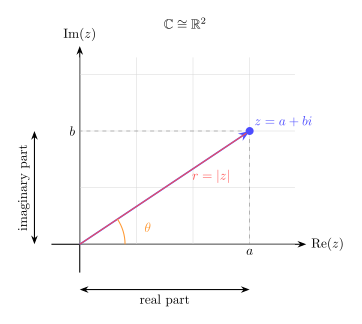
Figure 1: Conversion between polar and Cartesian forms of complex numbers.
You may recognize Figure 1 isomorphism between C \mathbb{C} C R 2 \mathbb{R^2} R 2
Figure 1 polar form of complex with magnitude r = ∣ z ∣ r=|z| r = ∣ z ∣ θ = arctan ( b a ) \theta=\arctan{(\frac{b}{a})} θ = arctan ( a b )
z = r cos ( θ ) + i r sin ( θ ) . z = r \cos{(\theta)} + ir\sin{(\theta)}. z = r cos ( θ ) + i r sin ( θ ) . While Eq. (5)
Euler’s formula, called “our jewel” by Richard Feynman, establishes a profound connection between trigonometry and complex numbers.
Euler’s Formula:
e i θ = cos ( θ ) + i sin ( θ ) e^{i\theta} = \cos(\theta) + i \sin(\theta) e i θ = cos ( θ ) + i sin ( θ ) Or, multiplying through by r r r
r e i θ = r cos ( θ ) + i r sin ( θ ) r e^{i\theta} = r \cos(\theta) + i r \sin(\theta) r e i θ = r cos ( θ ) + i r sin ( θ ) Euler’s Identity ¶ When θ = π \theta=\pi θ = π
e i π = − 1 + i ⋅ 0 e^{i\pi} = -1 + i \cdot 0 e iπ = − 1 + i ⋅ 0 or
e i π + 1 = 0 e^{i\pi} + 1 = 0 e iπ + 1 = 0 This is known as Euler’s identity , which relates five fundamental mathematical constants: e e e i i i π \pi π
Let f ( θ ) = cos ( θ ) + i sin ( θ ) e i θ f(\theta) = \frac{\cos(\theta) + i \sin(\theta)}{e^{i\theta}} f ( θ ) = e i θ c o s ( θ ) + i s i n ( θ )
d f ( θ ) d θ = d d θ cos ( θ ) + i sin ( θ ) e i θ = d d θ e − i θ ( cos ( θ ) + i sin ( θ ) ) = − i e − i θ ( cos ( θ ) + i sin ( θ ) ) + e − i θ ( − sin ( θ ) + i cos ( θ ) ) = e − i θ ( − i cos ( θ ) + sin ( θ ) − sin ( θ ) + i cos ( θ ) ) = e − i θ ( 0 ) = 0 \begin{split}
\frac{d f(\theta)}{d\theta} &= \frac{d}{d\theta} \frac{\cos(\theta) + i \sin(\theta)}{e^{i\theta}}\\
&= \frac{d}{d\theta} e^{-i \theta}(\cos(\theta) + i \sin(\theta))\\
&= -i e^{-i \theta}(\cos(\theta) + i \sin(\theta)) + e^{-i \theta}(-\sin(\theta) + i \cos(\theta))\\
&= e^{-i \theta}(-i\cos(\theta) + \sin(\theta) - \sin(\theta) + i \cos(\theta))\\
&= e^{-i \theta}(0)\\
&= 0
\end{split} d θ df ( θ ) = d θ d e i θ cos ( θ ) + i sin ( θ ) = d θ d e − i θ ( cos ( θ ) + i sin ( θ )) = − i e − i θ ( cos ( θ ) + i sin ( θ )) + e − i θ ( − sin ( θ ) + i cos ( θ )) = e − i θ ( − i cos ( θ ) + sin ( θ ) − sin ( θ ) + i cos ( θ )) = e − i θ ( 0 ) = 0 Since d f d θ = 0 \frac{df}{d\theta} = 0 d θ df = 0 f ( θ ) f(\theta) f ( θ )
At θ = 0 \theta = 0 θ = 0
f ( 0 ) = 1 + 0 i 1 = 1 f(0) = \frac{1 + 0i}{1} = 1 f ( 0 ) = 1 1 + 0 i = 1 Therefore f ( θ ) = 1 f(\theta) = 1 f ( θ ) = 1 θ \theta θ
e i θ = cos ( θ ) + i sin ( θ ) e^{i\theta} = \cos(\theta) + i \sin(\theta) e i θ = cos ( θ ) + i sin ( θ ) Solving Problems Involving i i i ¶ Euler’s formula can help solve otherwise extremely difficult problems involving i i i e i θ = cos ( θ ) + i sin ( θ ) e^{i\theta} = \cos(\theta) + i \sin(\theta) e i θ = cos ( θ ) + i sin ( θ ) θ = π 2 \theta=\frac{\pi}{2} θ = 2 π
e i π 2 = cos ( π 2 ) + i sin ( π 2 ) = 0 + 1 i = i \begin{split}
e^{\frac{i\pi}{2}} &= \cos(\frac{\pi}{2}) + i \sin(\frac{\pi}{2})\\
&=0+1i\\
&=i
\end{split} e 2 iπ = cos ( 2 π ) + i sin ( 2 π ) = 0 + 1 i = i Solving i i i^i i i ¶ Eq. (16) i i i^i i i
i i = ( e i π 2 ) i = e i 2 π 2 = e − π 2 . \begin{split}
i^i &= (e^{\frac{i\pi}{2}})^i\\
&= e^{\frac{i^2\pi}{2}}\\
&= e^{-\frac{\pi}{2}}.
\end{split} i i = ( e 2 iπ ) i = e 2 i 2 π = e − 2 π . Somewhat surprisingly, it turns out that i i i^i i i 1 5 \frac{1}{5} 5 1
Use of Euler’s formula can simplify trigonometric derivations by transforming geometric problems into algebraic ones. A pair of trigonometric identities that we will make use of later in the book are the sine and cosine addition formulae , given as
and
cos ( α + β ) = cos ( α ) cos ( β ) − sin ( α ) sin ( β ) . \cos{(\alpha + \beta)} = \cos{(\alpha)}\cos{(\beta)} - \sin{(\alpha)}\sin{(\beta)}. cos ( α + β ) = cos ( α ) cos ( β ) − sin ( α ) sin ( β ) . While these can be proven purely geometrically, Euler’s formula gives us an arguably far simpler algebraic method to prove them instead.
Using ℜ ( z ) \Re(z) ℜ ( z ) z z z ℑ ( z ) \Im(z) ℑ ( z )
cos ( α + β ) = ℜ ( e i ( α + β ) ) \cos{(\alpha + \beta)} = \Re(e^{i(\alpha + \beta)}) cos ( α + β ) = ℜ ( e i ( α + β ) ) and
sin ( α + β ) = ℑ ( e i ( α + β ) ) . \sin{(\alpha + \beta)} = \Im(e^{i(\alpha + \beta)}). sin ( α + β ) = ℑ ( e i ( α + β ) ) . Note that
e i ( α + β ) = e i α e i β = ( cos ( α ) + i sin ( α ) ) ( cos ( β ) + i sin ( β ) ) = cos ( α ) cos ( β ) − sin ( α ) sin ( β ) + i sin ( α ) cos ( β ) + i cos ( α ) sin ( β ) = [ cos ( α ) cos ( β ) − sin ( α ) sin ( β ) ] + i [ sin ( α ) cos ( β ) + cos ( α ) sin ( β ) ] . \begin{split}
e^{i(\alpha + \beta)} &= e^{i\alpha} e^{i\beta} \\
&= (\cos{(\alpha)} + i\sin{(\alpha)})(\cos{(\beta)} + i\sin{(\beta)})\\
&= \cos{(\alpha)}\cos{(\beta)} - \sin{(\alpha)}\sin{(\beta)} \\
&\quad + i\sin{(\alpha)}\cos{(\beta)} + i\cos{(\alpha)}\sin{(\beta)}\\
&= [\cos{(\alpha)}\cos{(\beta)} - \sin{(\alpha)}\sin{(\beta)}]\\
&\quad + i[\sin{(\alpha)}\cos{(\beta)} + \cos{(\alpha)}\sin{(\beta)}].
\end{split} e i ( α + β ) = e i α e i β = ( cos ( α ) + i sin ( α ) ) ( cos ( β ) + i sin ( β ) ) = cos ( α ) cos ( β ) − sin ( α ) sin ( β ) + i sin ( α ) cos ( β ) + i cos ( α ) sin ( β ) = [ cos ( α ) cos ( β ) − sin ( α ) sin ( β ) ] + i [ sin ( α ) cos ( β ) + cos ( α ) sin ( β ) ] . Combining Eq. (22) (23)
sin ( α + β ) = sin ( α ) cos ( β ) + cos ( α ) sin ( β ) . \sin{(\alpha + \beta)} = \sin{(\alpha)}\cos{(\beta)} + \cos{(\alpha)}\sin{(\beta)}. sin ( α + β ) = sin ( α ) cos ( β ) + cos ( α ) sin ( β ) . Similarly, combining Eq. (21) (23)
cos ( α + β ) = cos ( α ) cos ( β ) − sin ( α ) sin ( β ) . \cos{(\alpha + \beta)} = \cos{(\alpha)}\cos{(\beta)} - \sin{(\alpha)}\sin{(\beta)}. cos ( α + β ) = cos ( α ) cos ( β ) − sin ( α ) sin ( β ) .